Did you know more than 43 million students go to college in India?
It represents years of relentless study, monumental financial sacrifices by parents, and a legitimate gateway to corporate employment or government services.
However, the thriving education sector has also given rise to a dark parallel economy: the proliferation of unaccredited diploma mills.
The University Grants Commission (UGC), India’s statutory regulatory body under the Union Ministry of Education, has issued a critical national alert blacklisting 32 fake universities operating illegally across 12 Indian states and Union Territories. These institutions look, advertise, and operate like legitimate colleges, yet they possess zero legal authority to grant undergraduate or postgraduate degrees under the UGC Act.
If you or your children are planning to apply to college in India, understanding this massive higher education fraud is an absolute necessity. Enrolling in an unapproved institution can permanently derail an academic career, invalidate your qualifications, and drain family savings.
1. The Real Issue: Inside India’s Fake University Crisis
The underlying mechanics of this fraud are simple yet deeply damaging. Under Section 22 of the UGC Act, 1956, degrees in India can be conferred only by a university established under a Central Act, a State Act, or a Provincial Act, or by an institution explicitly recognized as a “Deemed-to-be University”. The 32 blacklisted entities satisfy none of these conditions.
Data released by the UGC indicates an alarming concentration of these illegal setups within metropolitan areas and major regional education hubs.
In addition to these hubs, newer states have recently joined the list, demonstrating the geographical expansion of these illegal networks. Single unapproved institutions have been officially flagged in Haryana (Magic & Art University, Faridabad), Jharkhand (Daksha University, Ranchi), Rajasthan (Rajeev Gandhi Institute of Technology & Management, Bhiwadi), and Arunachal Pradesh (Indian Institute of Alternative Medicine).
The real-world consequence for an unsuspecting student graduating from one of these 32 unaccredited institutions is total disqualification during background checks. Because these degrees are completely invalid for employment, civil service exams, and higher education enrollment, corporations and government offices discard them instantly. Years of hard work yield nothing more than a worthless piece of paper.
2. How Scammers Exploit Students and the Admission System?
Understanding why fake universities continue to thrive requires analyzing the systemic loopholes and consumer vulnerabilities they exploit:
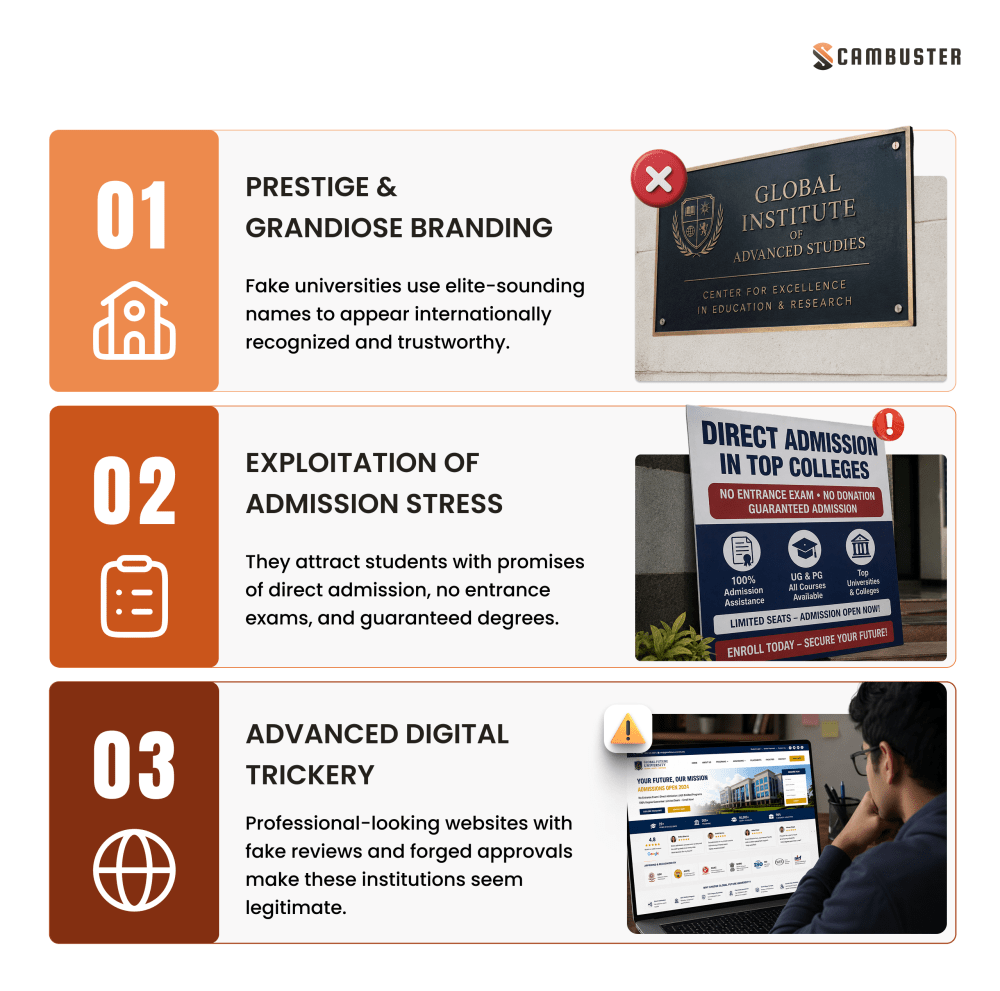
- Prestige & Grandiose Branding: Fraudulent operators deliberately choose deceptive titles designed to sound elite or internationally connected. By utilizing words like “United Nations,” “Vocational,” or “Alternative Medicine,” they fool applicants into believing they are entering a globally recognized or specialized program.
- Exploitation of Admission Stress: Demand for seats in India’s top colleges far outstrips supply, pushing cut-off percentages to extreme heights. Fraudulent colleges target students struggling with low marks or exam stress by promising “direct admission,” “zero entrance requirements,” and “flexible distance learning degrees” without standard academic scrutiny.
- Advanced Digital Trickery: Scammers leverage highly professional websites complete with stock photos of modern campuses, fabricated student reviews, and forged government accreditation stamps. On a smartphone, their digital portal looks just as authentic as an official state university page.
3. Protect Your Future: Spot the Red Flags with Scambuster
While the UGC coordinates with state education departments to initiate legal enforcement, the slow pace of judicial crackdowns means personal vigilance is your best defense. This is where proactive digital safety tools like Scambuster become invaluable.
Scambuster operates as a crowdsourced, community-driven warning network. If you encounter an institute or an online educational consultant making highly suspect claims—such as pressuring you for an immediate financial deposit, guaranteeing a degree without exams, or refusing to show an official UGC registration certificate—you can log it on Scambuster immediately.
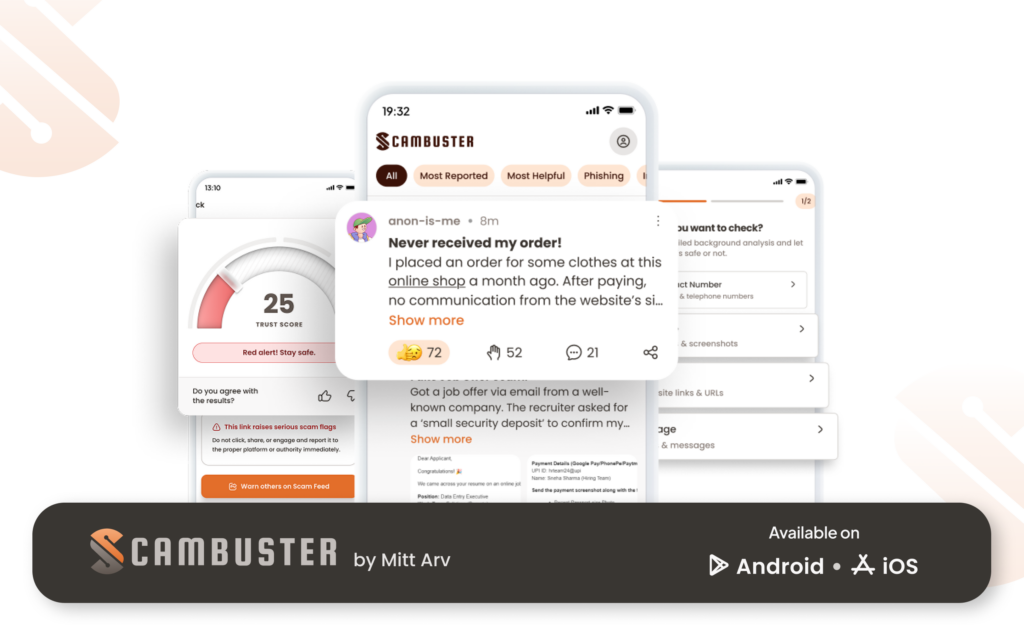
Reporting suspicious admission offers on Scambuster builds a shared repository of data that protects other vulnerable families across the country. Additionally, the platform provides clear guidance on how to route complaints straight to local police cyber cells and the Indian Cybercrime Coordination Centre (I4C), accelerating enforcement against rogue operators.
4. Frequently Asked Questions (FAQs)
Q1: How can a student verify if a university is officially recognized by the Indian government?
A: Always check the official website of the University Grants Commission (ugc.gov.in). The UGC maintains complete, live directories categorized by Central, State, Deemed, and Private Universities. If an institution’s exact legal name is absent from these lists, it is not authorized to award degrees.
OpIndia
Q2: What should I do if I accidentally enrolled in one of the 32 fake universities?
A: Exit the institution immediately. Submit a written request demanding a full refund of your fees under national consumer protection laws, and file a formal grievance on the government’s consumer helpline. Concurrently, register a complaint with your local cyber police cell and flag the institute on Scambuster to alert your peers.
Q3: Can an unapproved university degree become valid if the college gains accreditation later?
A: No. Legality cannot be applied retroactively to degrees or diplomas distributed while the establishment was actively unauthorized. Any certificate printed during their period of illegal operation remains permanently invalid for job placement and formal educational progression.
Q4: Do these 32 blacklisted colleges have the right to offer “diploma” or “certificate” programs?
A: While specific technical diplomas fall under other bodies like the AICTE, the institutions highlighted on the UGC list are completely unauthorized entities operating outside the legal framework of Indian higher education. Their certificates carry no official recognition and are rejected by formal employers.
India Today
Q5: Why doesn’t the government shut down these fake universities permanently?
A: Education is a concurrent list subject in India, meaning enforcement requires active participation from state law enforcement agencies. Many of these entities manipulate legal loopholes, re-register under slightly altered corporate names, or move their administrative centers across state lines to evade police action.
Q6: Are degrees earned via distance education or online modes from these colleges valid?
A: Absolutely not. For any university to offer distance or online courses, it must obtain specific validation from the UGC’s Distance Education Bureau (DEB). Since these 32 colleges are entirely unapproved, all of their teaching formats are fraudulent.
India Today
Q7: How can I differentiate between a fake university and a legitimate autonomous college?
A: Autonomous colleges are always formally affiliated with a recognized parent university (e.g., Delhi University or Mumbai University), which ultimately evaluates the students and prints the actual degree. Fake universities operate completely independently and print their own invalid certificates.
Q8: What are the primary warning signs of an admission scam?
A: High-pressure sales tactics demanding immediate cash deposits, a lack of physical campus infrastructure, missing verification codes on the UGC portal, and promises of clearing multi-year degree courses in a single sitting or via shortcuts.
Q9: Are parents and students legally penalized for taking admission to these institutes?
A: No, students and parents are legally viewed as victims of institutional fraud. However, intentionally using a known invalid degree to apply for government employment or corporate jobs can lead to criminal charges for forgery and fraud during background verification.
T.I.M.E. Events & Notifications – Stay Updated with Latest Exam News
Q10: Where can I check the absolute newest state-wise list of blacklisted institutions?
A: The definitive resource is the official UGC notice board, which is updated regularly as new unapproved entities are uncovered by regulatory tracking teams.